

Thinking 21st century art in the world from Niigata
Echigo-Tsumari Art Field - Official Web Magazine
Artwork / Antony Gormley
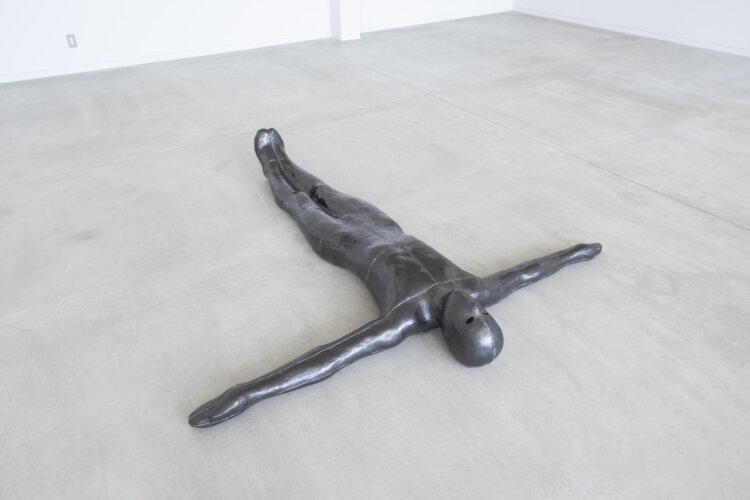
FILL
Artwork / Antony Gormley
FILL
Interview with Antony Gormley / "The body can be filled with the sky. "
Interviewer and translator: Art Front Gallery / Text and editor: NPO Echigo-Tsumari Satoyama Collaborative Organization
20 February 2026
Antony Gormley is one of the most important artists in contemporary sculpture. Through the body, he has consistently explored the relationship between the human being and nature, space, and the cosmos. For Gormley, the question “What is sculpture?” is inseparable from the more fundamental question “What does it mean to be human?” He understands sculpture not as a mere object, but as a way of thinking through bodily presence and spatial experience, and believes that the very act of “making” forms the foundation of human history.
In Echigo-Tsumari, Gormley permanently installed “ANOTHER SINGULARITY” (2009), created within a traditional Japanese house, and “MAN: ROCK V” (2024) at Kōryū Shrine, made from a stone taken from the Shinano River. In places where human activity and nature have intersected over long periods of time, he has developed works that connect the body, architecture, and landscape.
“FILL” marks his third work in this region. Cast from the artist’s own body and made of lead, this early work is a significant piece that reveals the origins of Gormley’s thinking. Focusing on the contrast between the darkness within the body and the sky and light that extend beyond it, the work challenges the upright, heroic figure typical of traditional sculpture and re-situates the body within its relationship to the earth and the planet. Even in an age of increasing virtualization, Gormley’s work quietly questions our relationship to the ground beneath our feet through sculpture as material presence.
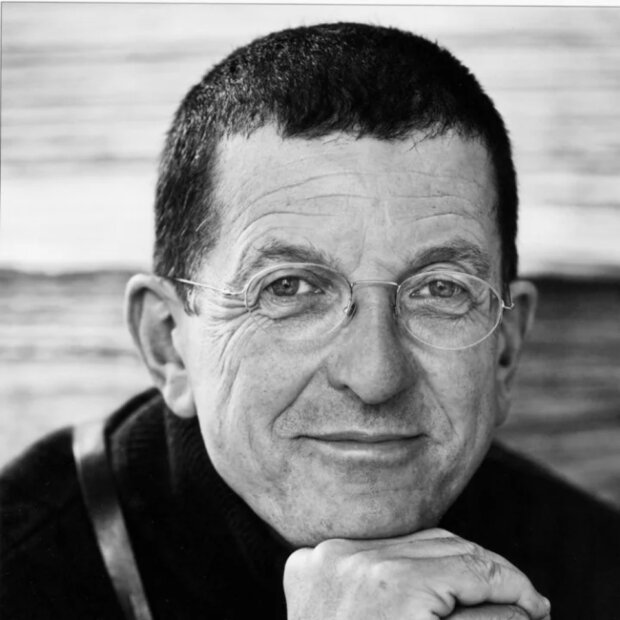
Profile
Antony Gormle
UK
Born in London, England, in 1950, Antony Gormley is widely acclaimed for his sculptures, installations, and public artworks that explore the relationship between the human body and space.
Since the 1960s, his work has developed through a critical engagement with his own body and those of others, extending the possibilities opened up by sculpture while confronting a fundamental question: what is the position of the human being in relation to nature and the cosmos?
Gormley continues to conceive of artistic space as a place where new actions, thoughts, and emotions can emerge.
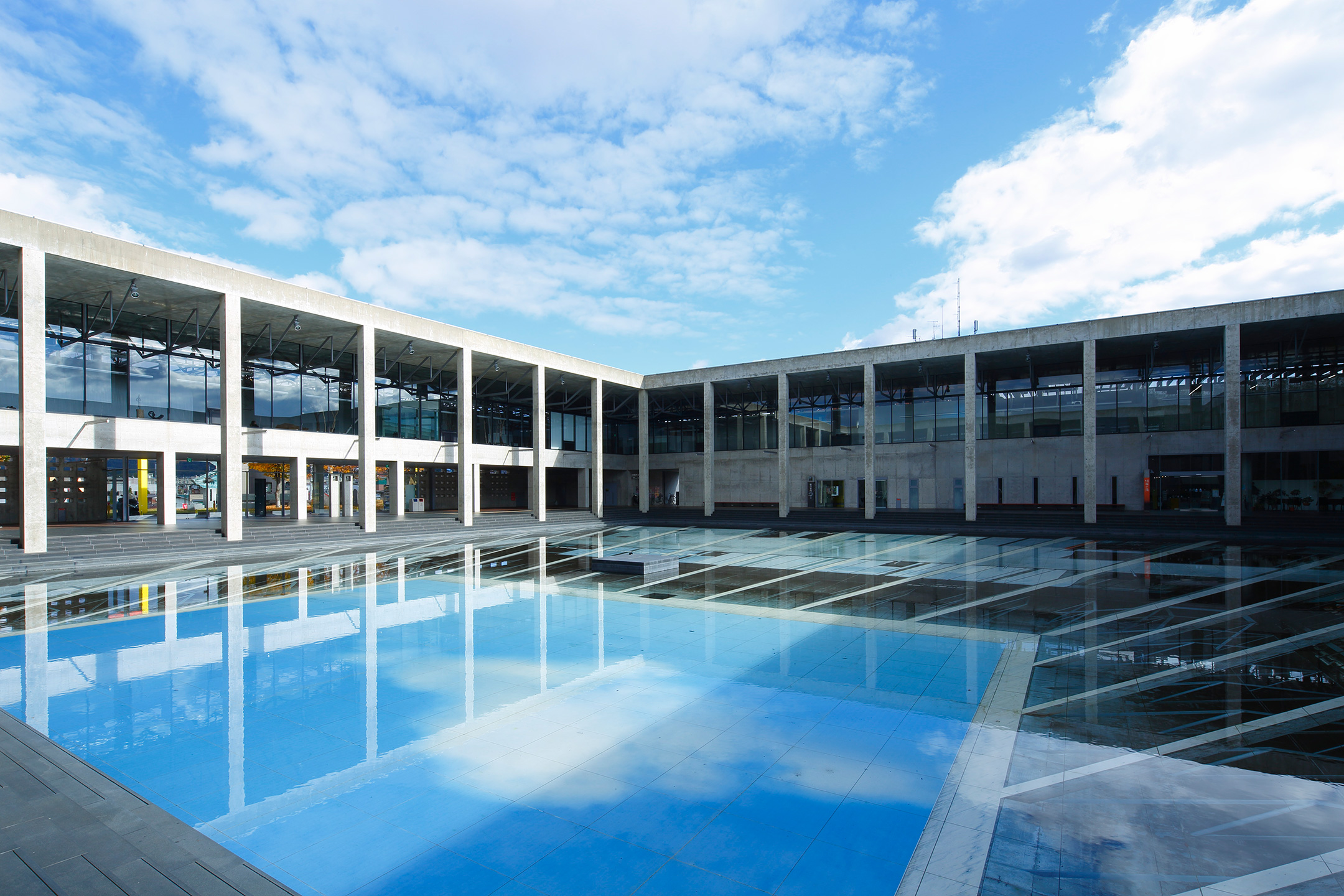
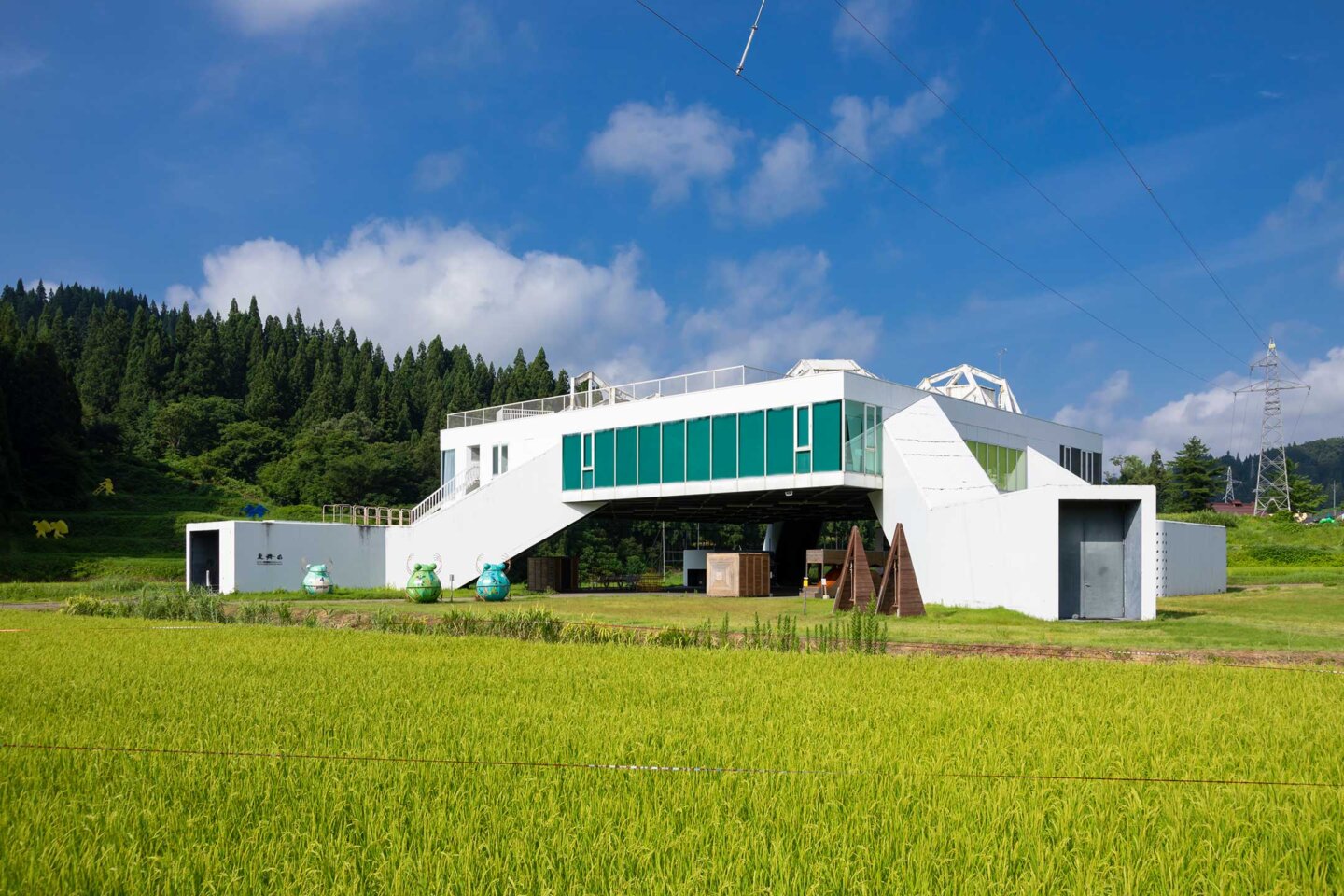
◀ Museum on Echigo-Tsumari, MonET
Photo by Kioku Keizo
Q: What does “FILL” mean to you, and why did you choose to present this work in Echigo-Tsumari?
Sculpture often attempts to mark a place by erecting something vertical that plugs into the sky. I want my work to engage with space at large and link body with ground. I hope that this work, “FILL”, suggests that the body can be filled with the sky.
It is one of my earliest works in lead and was shown in my first gallery exhibition in New York at Salvatore Ala in 1984. Many of the early lead body-case works are pierced at vital thresholds. The previous three-part work, Three Calls: Pass Cast and Plumb, refers to the three primary means by which we explore the world: thought, word and action. This work, “FILL”, expresses a fundamental relation between perception and the elements.
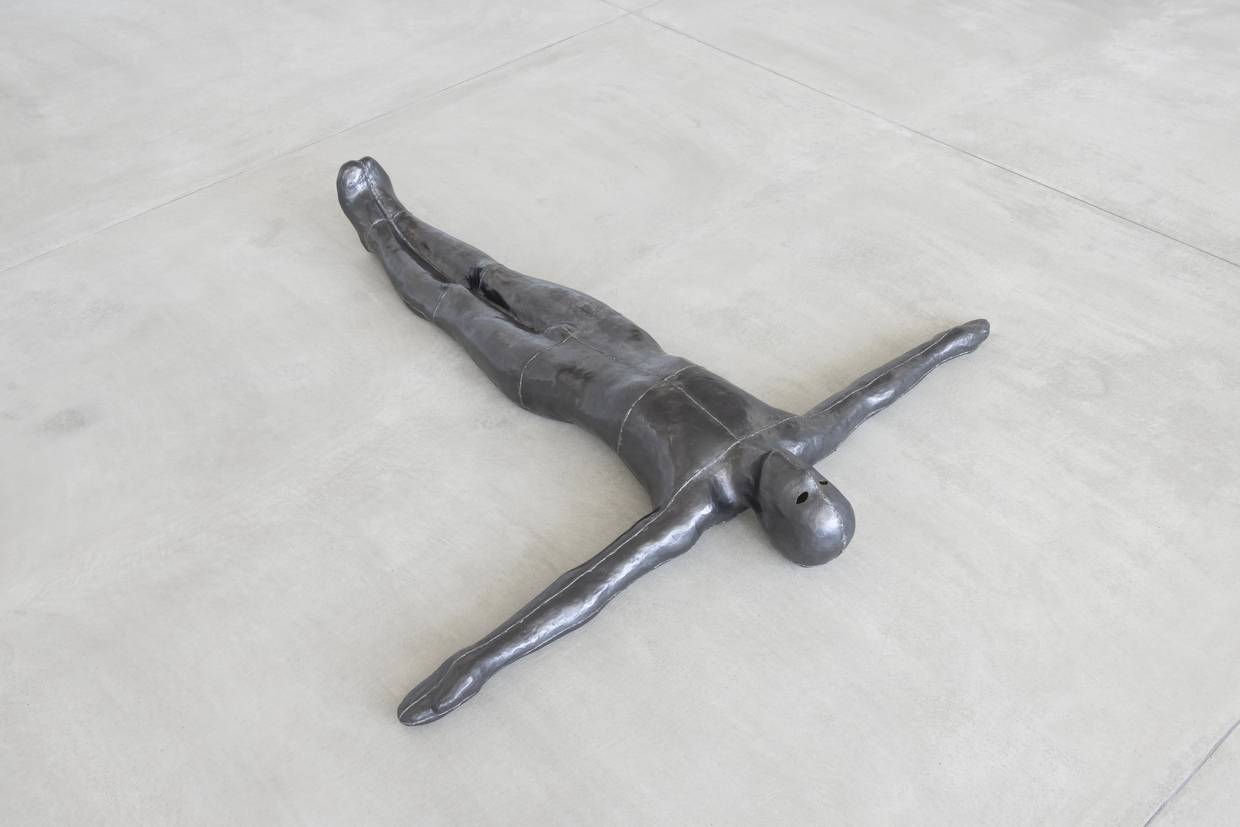
Photo by Nakamura Osamu
Q: Do you see any conceptual or formal continuity or development among your three works in Echigo-Tsumari?
They all treat the location of human life, perception and feeling as an open space of unknowingness. They run contrary to the sculptural tradition that concentrated on how light reveals form, in favour of thinking of the space of being as one that is in continuity with space at large, always relating to the trace of a body rather than its representation.
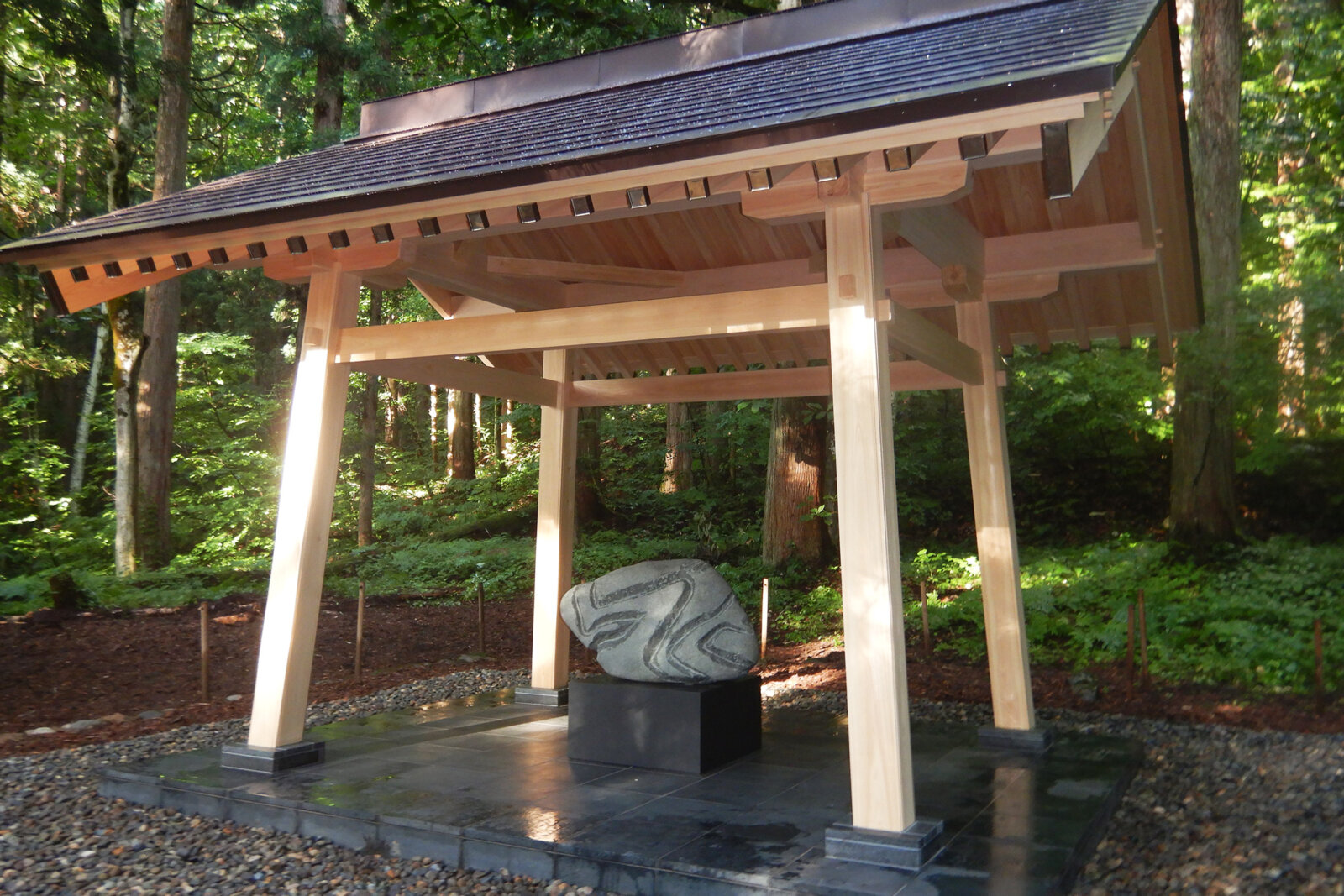
MAN: ROCK Ⅴ, 2024
Echigo-Tsumari Art Triennale 2024
Q: Could you share your impressions of your first visit to Echigo-Tsumari?
The whole experience of making “ANOTHER SINGULARITY” (Japan), with the collaboration of the community and the kind family who bequeathed their house to the project, made a profound impression on me.
The memory of lying on the floor of that hand-built house with one of the daughters of the man who built it, staring up at the main pillar supporting the roof and being told the story of how that tree trunk had been brought down from the forest by hand by him and other members of the village, is unforgettable. The stories of how the family survived winters in which snowfall could reach as much as 6 metres – when they gave up using the ground floor door in favour of climbing in and out of the upper windows – have stayed with me.
I am amazed and inspired by the stories of life in the mountains of Niigata Prefecture and the resilience and creativity of the people of that north-western part of Honshu.
I love the ambition of the Echigo-Tsumari project, where art and reflexivity are interwoven with the human and built structures of the region. I regard it as a huge privilege to be part of it.

ANOTHER SINGULARITY
Echigo-Tsumari Art Triennale 2009
Photo by Miyamoto Takenori+Seno Hiromi
Q: Do you feel that your exploration of the relationship between the body, space, and nature resonates with the landscape and ways of life in Echigo-Tsumari?
Absolutely. As we move into an ever-more algorithmically controlled, internet-saturated world of digital communication, the reinforcement of first-hand, palpable experience is vital. I see my sculptures as reflexive instruments that allow us to sense anew our experience of being-in-the-world. Our bodies are primarily sensing instruments, part of a greater-than-human world in which everything is connected. It is only through our bodies and our animal nature that we can recognise our part in the entanglement of all life.
Q: You have said that “sculpture is a way of thinking about the world according to the principles of things.” In an age of increasing virtualization, what role and possibilities do you see for sculpture today?
Sculpture is a thing in the world of things. Sculpture reinforces being-in-the-world. In a time in which the visual is reinforced by instantly made images that are instantly obsolete, sculpture reinforces the palpable as the root of the intelligible.
I am committed to sculpture because it is not about making pictures of things but about making things that change a world made up of things. To make work that acts in and on the world rather than representing it is at the core of my purpose.
This spring, in addition to ”FILL”, you can see a total of three artworks, including two other existing artworks scattered around Echigo-Tsumari. Be sure to visit the locations and experience the presence of the artworks and the atmosphere that permeates the space.
*Opening times may change depending on snow conditions. Please check the official website for the latest information.
Facility information
Museum on Echigo-Tsumari, MonET
The works on display are deeply concerned with the characteristics of Echigo-Tsumari’s climate and culture, or allow the viewer to experience the transformation of space and time of the place where the work is exhibited.
Open|10:00-17:00(Last entry17:30)※Closed on Tues and Wed except holidays
Fee|[Permanent exhibition] Adult: ¥1000, Children6-15 years old : ¥500 [Special exhibition (including permanent exhibition) ] Adult: ¥1200, Children6-15 years old : ¥600
Address|2-71-1-6 Honcho Tokamachi-city, Niigata Prefecture
Artworks1
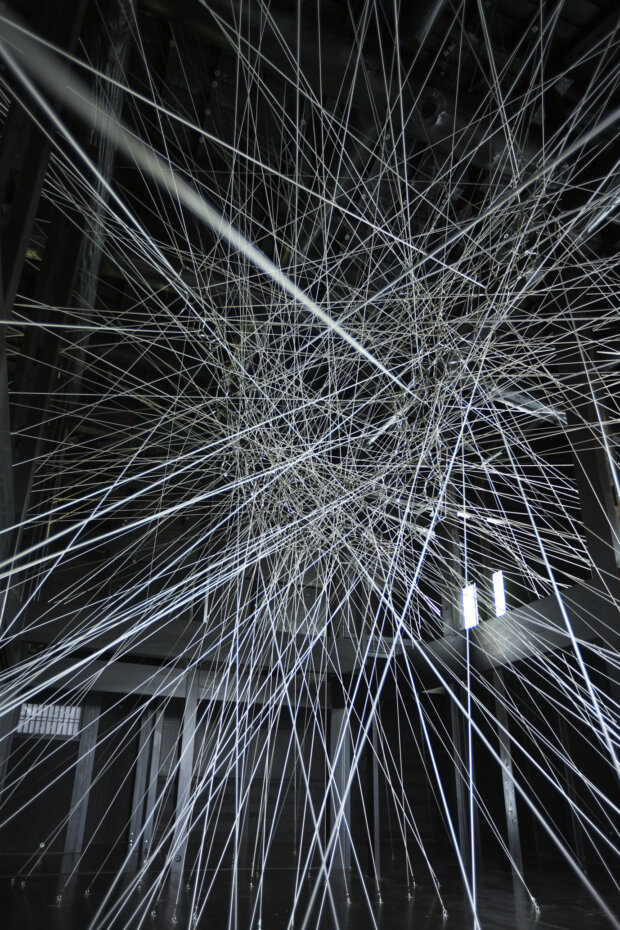
ANOTHER SINGULARITY
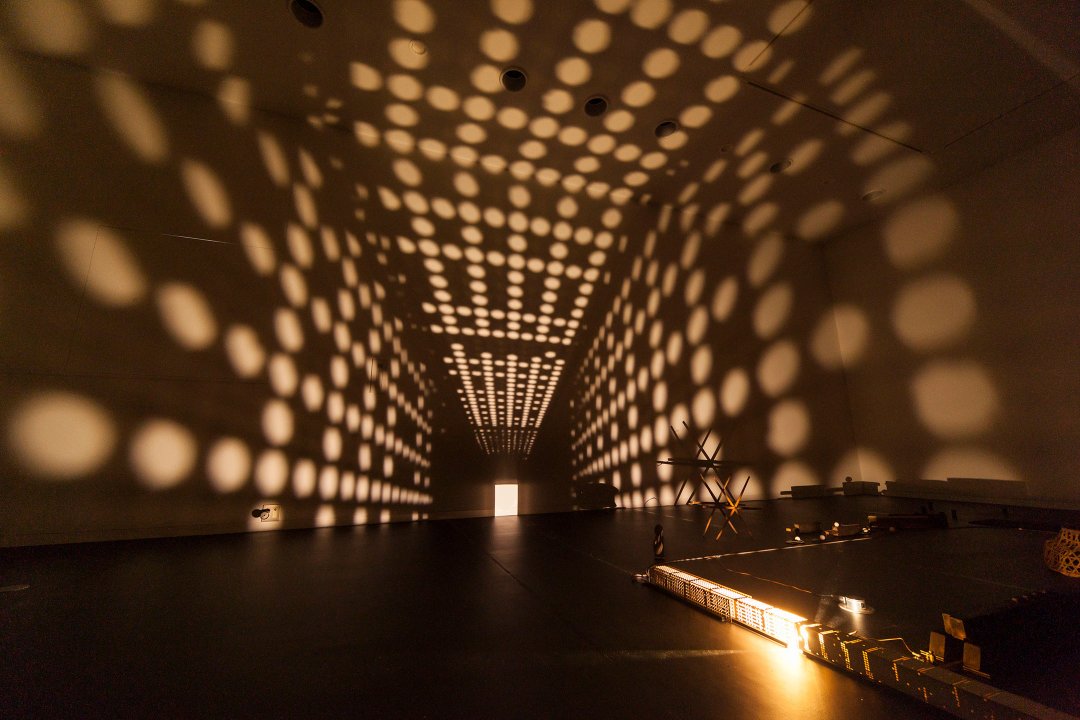
With its walls removed, the structure of a house is laid bare. Six hundred and eighty two cords cut through the pillars and beams of the space from walls, floor and ceiling, and condense around the volume of the artist’s body in a central polyhedral matrix. The title “Another Singularity” refers to the origin of the universe, and tries to particularise and make intimate the moment in which mass, space and time arose arose 13.7 billion years ago.
Open|2026/4/25, 26, 29, 5/2, 3, 4, 5, 6
Fee|Adult: ¥400, Children 6-15 years old: ¥200
Address|913 Inu, Tokamachi-city, Niigata
Artworks2
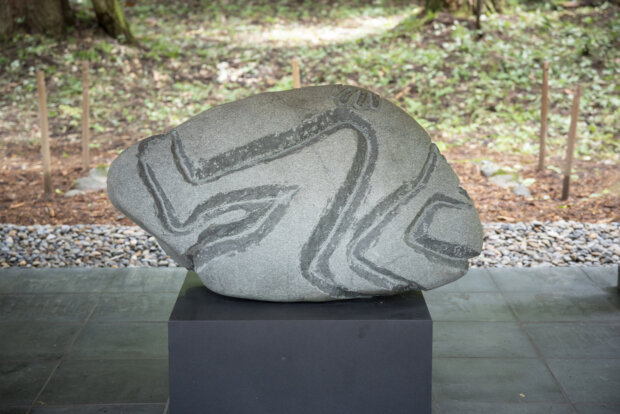
MAN: ROCK Ⅴ, 2024
Koryu Jinja Shrine is said to have been founded in 1333 by a warrior of the Nitta Yoshisada clan. The enshrined deity is Toyotama-hime, and after the Showa period, the deity Takaogami no Kami was added. Then in 1929, twelve other shrines were consolidated into this site. The artist’s Man Rock series began in 1979. The artist who claims that “matter and spirit are one,” collaborated with a local stonemason to carve a form engaged in a gentle embrace on a naturally shaped stone from Shinano River. This stone sculpture, on the boundary between a drawing and a sculpture, is housed within a structure designed to resemble the chozu-ya (water ablution pavilion) of the Koryu Jinja Shrine. Placed within a lushly forested shrine grove, this piece is intended to gradually return to nature. It invites reflection on humanity’s interdependence with the Earth and our role as
both inhabitants and creators of this planet.
Closed|Closed on Tue & Wed except holidays (Outdoor artworks can be viewed even on regular closing day.) ※The opening times may change depending on the snow conditions. Please check the official website for the latest information.
Addres|2581-Ko, Nakajo Otsu, Tokamachi-City

Articles
Latest Articles
Stay connected with the ETAT official social media to receive the latest news and event information, and the many seasonal faces of Echigo-Tsumari as well as new issue of the ETAT official media, “Art from the Land”.